
Different Scenarios, Different Choices
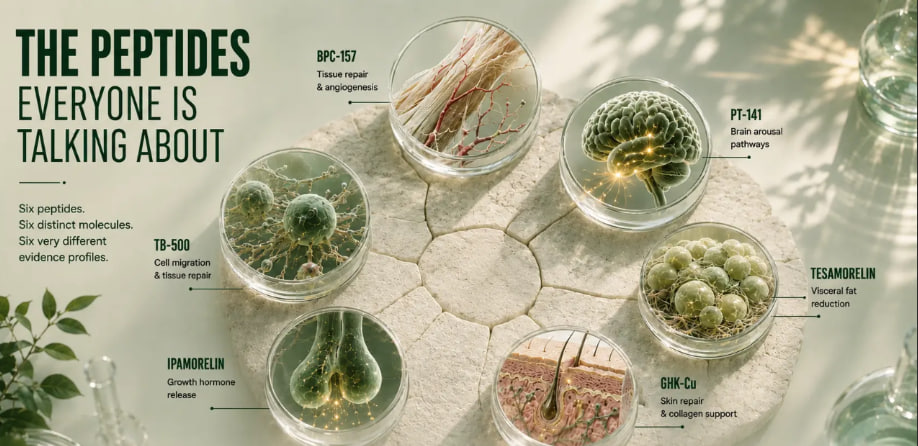
Each peptide has its specialty. BPC-157, TB-500, PT-141, Ipamorelin, Tesamorelin, and GHK-Cu suit different use scenarios. Understanding these scenarios and stacking options helps customers make the most of each product and enjoy a better experience.
Scenario 1: Athletic Recovery and Soft Tissue Repair
If you train frequently, get injured easily, or want faster recovery, BPC-157 and TB-500 are common choices.
BPC-157: Supports natural repair of tendons, ligaments, muscles, and the gut. Preclinical studies suggest it supports angiogenesis, nitric oxide signaling, and growth factor activity.
TB-500: Derived from thymosin beta-4, it helps transport actin to injury sites, supporting soft tissue recovery and flexibility.
Stacking suggestion: The two are often stacked as the "Wolverine Stack," suitable for those with higher recovery needs. Users report this combination supports faster wound healing and soft tissue recovery.
Scenario 2: Body Composition and Anti-Aging
If you focus on body composition, abdominal fat, or anti-aging, Ipamorelin and Tesamorelin are popular choices.
Ipamorelin: A highly selective growth hormone secretagogue that stimulates natural pituitary release via GHS-R1a while avoiding significant effects on cortisol, ACTH, prolactin, or appetite. It suits those focused on anti-aging, recovery capacity, and body composition.
Tesamorelin: An FDA-approved GHRH analog marketed as Egrifta, backed by full Phase III data showing significant visceral fat reduction. In March 2025, the FDA also approved EGRIFTA WR, a once-weekly formulation.
Stacking suggestion: These can be used separately based on goals. Ipamorelin suits daily growth hormone support, while Tesamorelin targets visceral fat reduction.
Scenario 3: Sexual Health and Quality of Life
If you focus on libido and sexual health, PT-141 is worth exploring.
PT-141 (bremelanotide, Vyleesi): An FDA-approved cyclic heptapeptide for premenopausal HSDD. It acts through melanocortin MC3R and MC4R receptors in the brain rather than on blood vessels like Viagra. For PDE-5 non-responders, PT-141 may also help.
Stacking suggestion: PT-141 has a unique mechanism and is suitable for standalone use. For other needs, consult professional advice based on individual circumstances.
Scenario 4: Skin Repair and Anti-Aging
If you focus on skin condition, collagen, and anti-aging, GHK-Cu is a top choice.
GHK-Cu: A naturally occurring copper-binding peptide found in human plasma, saliva, and wound exudate. Multiple controlled human studies confirm it improves skin density, thickness, collagen synthesis, wrinkle depth, and elasticity. Since GHK-Cu levels decline with age—from about 200 ng/ml at 20 to about 80 ng/ml at 60—supplementation is especially appealing for those focused on skin health.
Stacking suggestion: GHK-Cu is suitable for topical application and can be combined with other skin care protocols.
Usage Notes: Injection and Half-Life
Most peptides require injection because oral use leads to rapid breakdown by digestive enzymes. Their short half-lives mean precise dosing strategies are necessary. Product choice should be based on individual needs, goals, and acceptable protocols.
Conclusion
BPC-157 and TB-500 suit athletic recovery, Ipamorelin and Tesamorelin suit body composition and anti-aging, PT-141 suits sexual health, and GHK-Cu suits skin repair. Choosing the right product and stacking approach for each scenario helps peptides better serve your health goals.